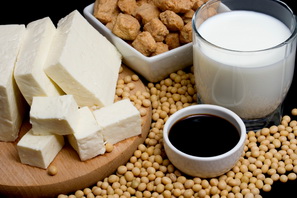
Usually when people think of getting healthy or cutting out the "bad" foods from their diet, they immediately think of taking a break from eating meat and dairy. This of course usually means the introduction of soy substitutes, soy milk, and soy meats. In fact one can find a soy substitute for just about anything.
But the question arises, is soy actually better for you? Is it the healthier way?
There is some alarming data that says unequivocally, NO. Take a look at this article by Dr. Mercola, The Evidence Against Soy.
The Evidence Against Soy
by Dr. Mercola
Dow Chemical and DuPont, the same corporations that brought misery and death to millions around the world through Agent Orange, are now the driving forces behind the promotion of soy as a food for humans. They are financing anti-meat and anti-milk campaigns aimed largely at those concerned about animal welfare and the environment, trying to convince them that imitations such as "soymilk" are not only healthier than the real thing, but better for the earth too.
There is no evidence that consuming soy products can improve health, reduce environmental degradation or slow global warming. In fact, the evidence suggests quite the opposite.
The studies below regarding the effects of soy on health are eye-opening, particularly the review by the American Heart Association -- which no longer supports the health claims about soy endorsed by the U.S. government.
If you were to carefully review the thousands of studies published on soy, I strongly believe you too would reach the conclusion that any possible benefits of consuming soy are FAR outweighed by the well documented risks.
Now, I’m not against all forms of soy.Properly fermented products like natto and tempeh have been consumed for centuries and do not wreak havoc in your body like unfermented soy products do.For example, the enzyme nattokinase—derived from natto--is a safer, more powerful option than aspirin to dissolve blood clots, and has been used safely for more than two decades.
Unfortunately, many Americans still believe that unfermented and processed soy products like soy milk, soy cheese, soy burgers and soy ice cream are good for them.
85 Percent of Consumers Believe the Lies About Soy
The rise of soy as a health food is in large part due to highly successful marketing to otherwise health conscious Americans who set the trend. According to the survey Consumer Attitudes About Nutrition 2008 (by the United Soybean Board), 85 percent of consumers now perceive soy products as healthy.
The survey also found that consumers:
rank soybean oil among the top three healthy oils, with 70 percent recognizing soy oil as a healthy oil, and
depend on soybean oil, commonly sold as vegetable oil, as one of their two most frequent cooking oils
This is a tragic case of shrewd marketing of misinformation and outright lies taking root among the masses, which will likely take some time to undo.
Ever since the U.S. Food and Drug Administration approved a health claim for soy foods in 1999 (which said diets low in saturated fat and cholesterol that include 25 grams of soy protein a day may reduce the risk of heart disease), soy sales have skyrocketed. In the years between 2000 and 2007, food manufacturers in the U.S. introduced over 2,700 new foods with soy as an ingredient, including 161 new products introduced in 2007 alone.
This has resulted in a booming multi-billion dollar business. From 1992 to 2007, soy food sales increased from a paltry $300 million to nearly $4 billion, according to the Soyfoods Association of North America.
However, the Weston A. Price Foundation, a nonprofit nutrition education foundation, submitted a petition to the Food and Drug Administration (FDA) in January of this year, asking them to retract its heart-health claim from soy in light of the inconsistent and contradictory evidence showing benefits, and its many proven health risks.
What’s So Wrong With Soy?
Unlike the Asian culture, where people eat small amounts of whole soybean products, western food processors separate the soybean into two golden commodities--protein and oil. And there is nothing natural or safe about these products.
“Today's high-tech processing methods not only fail to remove the anti-nutrients and toxins that are naturally present in soybeansbut leave toxic and carcinogenic residues created by the high temperatures, high pressure, alkali and acid baths and petroleum solvents."
Dr. Daniel also points out the findings of numerous studies reviewed by her and other colleagues -- that soy does not reliably lower cholesterol, and in fact raises homocysteine levels in many people, which has been found to increase your risk of stroke, birth defects, and yes: heart disease. Other common health problems linked to a high-soy diet include:
Thyroid problems, including weight gain, lethargy, malaise, fatigue, hair loss, and loss of libido
Premature puberty and other developmental problems in babies, children and adolescents
Despite these findings, many people still want to believe the hype, thinking that these studies must somehow be wrong. But the content of soy itself should be a clue. For example, non-fermented soy products contain:
Phytoestrogens (isoflavones) genistein and daidzein, which mimic and sometimes block the hormone estrogen
Phytates, which block your body's uptake of minerals
Enzyme Inhibitors, which hinder protein digestion
Hemaggluttin, which causes red blood cells to clump together and inhibits oxygen take-up and growth
High amounts of omega-6 fat, which is pro-inflammatory
You’re Consuming Soy Whether You’re Buying “Soy Products” or Not
Even if you know better than to gulp down large amounts of soy milk, slabs of tofu, and other soy snacks, you are still consuming soy if you’re eating processed food, in the form of soybean oil and lecithin. So depending on your dietary habits, your (unfermented) soy consumption could really add up.
In fact, Dr. Joseph Hibbeln at the National Institutes of Health told CNN.com he estimates that soybeans, usually in the form of oil, account for 10 percent of the average person’s total calories in the United States! When you consider that 90 percent of the money Americans spend on food goes toward processed food, this amount of “accidental” soy intake is not surprising. As a side note, I’d like to make a quick statement here to address some of my readers’ concerns about my reduced CoQ 10 supplement, ubiquinol, which also contain soy bean oil.
Unfortunately, the reduced CoQ 10 (ubiquinol) – which is the optimal form of CoQ 10 that your body needs, especially if you’re over 25 – is only produced by a multi-billion dollar Japanese pharmaceutical company that holds ALL the world patents on it. Hence, there’s no way to replace the soy, even though that would have been my preference.
However, as in all things, moderation is key. If I thought there were ANY significant health risks from consuming this small amount of soy oil, then I would not personally take two a day – which I do. I do however avoid all processed forms of soy products, and severely limit my intake of other unfermented soy, which is easy to do by simply avoiding processed and “fast” foods.
Which Soy Foods Should be Avoided … and How do You Avoid Them?
Because soy is so pervasive in the U.S. food supply, avoiding it is not an easy task.
The best way to completely avoid soy in the food supply is to buy whole foods and prepare them yourself. This may also be your only option if you’ve developed a soy allergy and need to eliminate soy from your diet entirely.
If you still prefer to buy readymade and packaged products, for whatever reason, Dr. Daniel offers a free Special Report, "Where the Soys Are," on her Web site. It lists the many "aliases" that soy might be hiding under in ingredient lists -- words like "boullion," "natural flavor" and "textured plant protein."
Which Soy Foods DO Have Health Benefits?
The few types of soy that ARE healthy are all fermented varieties. After a long fermentation process, the phytic acid and antinutrient levels of the soybeans are reduced, and their beneficial properties -- such as the creation of natural probiotics -- become available to your digestive system.
The fermentation process also greatly reduces the levels of dangerous isoflavones, which are similar to estrogen in their chemical structure, and can interfere with the action of your own estrogen production.
So if you want to eat soy that is actually good for you, following are all healthy options:
Natto, fermented soybeans with a sticky texture and strong, cheese-like flavor. It's loaded with nattokinase, a very powerful blood thinner. Natto is actually a food I eat regularly, as it is the highest source of vitamin K2 on the planet and has a very powerful beneficial bacteria, bacillus subtilis. It can usually be found in any Asian grocery store.
Tempeh, a fermented soybean cake with a firm texture and nutty, mushroom-like flavor.
Miso, a fermented soybean paste with a salty, buttery texture (commonly used in miso soup).
Soy sauce: traditionally, soy sauce is made by fermenting soybeans, salt and enzymes, however be wary because many varieties on the market are made artificially using a chemical process.
Other Unreasonable Happiness PostsYou Would Be Interested In
Then pay it forward. Help my Scholarship Students with their tuition and allow me to create more of my Free Programs and Shows for everyone.How? Just click below to Donate, any amount is greatly appreciated and it all goes to a good cause. Thank You, Sifu Marcus Lovemore
Please stop using non-stick cookware. Your cookware could be the cause of some of your major heath problems. And if you have and are using this cookware, you are gonna get a problem. No shit.
Below are three articles about the dangers of non-stick cookware and safer alternatives. The third is from Dr. Mercola's website, http://mercola.com/. It is primping their own product pretty hardcore. So lets get this straight: I am NOT endorsing Mercola's cookware. On the other hand I am not nescesarily apposed to them. Really, I'm in to Le Creuset cookware.
Sifu Marcus
Article #1
from
http://www.ewg.org/alternative-cookware
EWG finds heated Teflon pans can turn toxic faster
than DuPont claims
By Jane Houlihan, Vice President for Research; Kris Thayer, PhD, Senior Scientist; Jennifer Klein, EWG Chemist , May 2003
In two to five minutes on a conventional stovetop, cookware coated with Teflon and other non-stick surfacescan exceed temperatures at which the coating breaks apart and emits toxic particles and gases linked to hundreds, perhaps thousands, of pet bird deaths and an unknown number of human illnesses each year, according totests commissioned by Environmental Working Group (EWG).
In new tests conducted by a university food safety professor, a generic non-stick frying pan preheatedon a conventional, electric stovetop burner reached 736°F in three minutes and 20 seconds, with temperatures still rising when the tests were terminated. A Teflon pan reached 721°F in just five minutes under the same test conditions (See Figure 1), as measured by a commercially available infrared thermometer. DuPont studies show that the Teflon offgases toxic particulates at464°F. At 680°F Teflon pans release at least six toxic gases, including two carcinogens, two global pollutants, and MFA, a chemical lethal to humans at low doses. At temperatures that DuPont scientists claim are reached on stovetop drip pans (1000°F), non-stick coatings break down to a chemical warfare agent known as PFIB, and a chemical analog of the WWII nerve gas phosgene.
For the past fifty years DuPont has claimed that their Teflon coatings do not emit hazardous chemicals through normal use. In a recent press release, DuPont wrote that "significant decomposition of the coating will occur only when temperatures exceed about 660 degrees F (340 degrees C). These temperatures alone are well above the normal cooking range."
These new tests show that cookware exceeds these temperatures and turns toxic through the common act of preheating a pan, on a burner set on high.
In cases of "Teflon toxicosis," as the bird poisonings are called, the lungs of exposed birds hemorrhage and fill with fluid, leading to suffocation. DuPont acknowledges that the fumes can also sicken people, a condition called "polymer fume fever." DuPont has never studied the incidence of the fever among users of the billions of non-stick pots and pans sold around the world. Neither has the company studied the long-term effects from the sickness, or the extent to which Teflon exposures lead to human illnesses believed erroneously to be the common flu.
The government has not assessed the safety of non-stick cookware. According to a Food and Drug Administration (FDA) food safety scientist: "You won't find a regulation anywhere on the books that specifically addresses cookwares," although the FDA approved Teflon for contact with food in 1960 based on a food frying study that found higher levels of Teflon chemicals in hamburger cooked on heat-aged and old pans. At the time, FDA judged these levels to be of little health significance.
Of the 6.9 million bird-owning households in the US that claim an estimated 19 million pet birds, many don't know know that Teflon poses an acute hazard to birds. Most non-stick cookware carries no warning label. DuPont publicly acknowledges that Teflon can kill birds, but the company-produced public service brochure on bird safety discusses the hazards of ceiling fans, mirrors, toilets, and cats before mentioning the dangers of Teflon fumes.
As a result of the new data showing that non-stick surfaces reach toxic temperatures in a matter of minutes, EWG has petitioned the Consumer Product Safety Commission (CPSC) to require that cookware and heated appliances bearing non-stick coatings must carry a label warning of the acute hazard the coating poses to pet birds. Additionally, we recommend that bird owners completely avoid cookware and heated appliances with non-stick coatings. Alternative cookware includes stainless steel and cast iron, neither of which offgases persistent pollutants that kill birds.
Article #2
also from http://www.ewg.org
Canaries in the Kitchen
Alternatives to Non-Stick/Teflon Cookware
Statistics reported by the Cookware Manufacturers Association indicate that 90 percent of all the aluminum cookware sold in the United States in 2001 was coated with non-stick chemicals like Teflon (Cooks Illustrated, September 2002). Chemicals and tiny, toxic Teflon particles released from heated Teflon kill household pet birds. At least four of these chemicals never break down in the environment, and some are widely found in human blood. Consumers concerned about the effects of Teflon on human health and the environment should consider these alternatives:
Stainless Steel
Stainless steel is a terrific alternative to a non-stick cooking surface. Most chefs agree that stainless steel browns foods better than non-stick surfaces. In their 2001 review of sauté pans, Cooks Illustrated, an independent publication, chose a stainless steel pan over otherwise identical non-stick models. They also recommended stainless steel pan roasters over non-stick.
Cast Iron
Cast iron remains a great alternative to non-stick cooking surfaces. Lodge, America’s oldest family-owned cookware manufacturer, refers to their cookware as “natural non-stick.” Cast iron can be pre-heated to temperatures that will brown meat and will withstand oven temperatures well above what is considered safe for non-stick pans. Cast iron is extremely durable and can now be purchased pre-seasoned, ready-to-use.
Other Cooking Surfaces
Because Teflon coated non-stick surfaces fail to brown foods there has been a push to find other “non-stick” cookware coating that will allow the use of higher temperatures and still clean up easily. Some examples include ceramic titanium and porcelain enameled cast iron. Both of these surfaces are very durable, better at browning foods than PTFE (Teflon) non-stick coatings, and are dishwasher safe. In her New York Times piece, "In Search of a Pan That Lets Cooks Forget About Teflon," Marian Burros recommendsLe Creuset enameled cast iron pans with a matte black interior. Anodized aluminum is another alternative, but some people question its safety, citing evidence in some studies linking aluminum exposures to Alzheimers.
No matter how healthy your food is, if you're like most Americans you are probably making this mistake that can lead to cancer in the pancreas, liver, testicles or mammary glands – as well as miscarriages, thyroid problems & a weakened immune system…
For years, I've been working tirelessly to get the message out to you about all the dangers lurking about in your common, everyday cookware.
From the toxic chemicals present in non-stick surface pans, to the leaching of dangerous heavy metals into your food from a variety of other types of metal cookware -- I want you to know.
I've talked about it, written about it, done videos about it -- and tried every way I can think of, short of screaming from the rooftops -- to warn you of the terrible hazards to your health from most cookware out on the market today.
For those of you who might still be skeptical of the presence of these dangerous toxins making their way into your food -- and most assuredly into your body -- I finally have the proof.
Just take a look at this chart of a recent 2009 Heavy Metals Leaching Test performed on common types of cookware you probably use everyday.
And if that’s not bad enough, you have to be careful of the temperature you cook at. The dangers of commercial non-stick cookware are already well-known, but aluminum is also a heavy offender. The higher the temperature you use, the more danger you put yourself at. Aluminum and non-stick surfaces are both known to leach metals into the food you’re cooking.
There's no mistaking the clearly, non-toxic, healthier alternative in cookware.
But before I go on about all the amazing benefits and features of Mercola Healthy Chef Ceramic Cookware, let me ask you one simple question…
Are You Becoming Complacent with Your Food Preparation?
You may not even give a second thought about what you use to prepare your meals. You may even feel satisfied that you're doing everything you can for you health by eating as much raw and unprocessed food as possible.
Unfortunately, it may not be enough if you're not very selective in your food prep.
What about your cookware? What about that skillet you use to lightly cook your favorite wild-caught fish? Can you trust it to be safe for you and your family?
The answer is -- probably not... particularly if you use dangerous non-stick cookware.
The good news is -- I do have a healthy cookware solution for you that you can trust... a solution that uses a patented material made of 100% inorganic natural minerals and nature's own water.
My previous recommendation was an excellent porcelain cast iron cookware which really was an outstanding solution.
However, many found the heavy weight of cast iron to be a challenge. Due to the added weight, some people found the cookware cumbersome to lift and use when “flipping” certain foods while cooking, as well cleaning and storing.
So I did additional research and discovered what may be an even better solution that helps you become the Healthy Chef you've always wanted to be by…
And there are many more benefits to the Mercola Healthy Chef Ceramic Cookware I want to share with you.
But first, you should know...
Why You Can't Trust Your Health to Any Old Cookware Lurking in Your Cabinet
Non-stick cookware is the most popular cookware in America. So what's wrong with it?
Well, for starters, non-stick cookware contains perfluorooctanoic acid (PFOA), a synthetic chemical used in production that creates a soap-like slipperiness and non-stick finish.
Once heated, non-stick pans will quickly reach temperatures at which toxic fumes release into the air. And it doesn't take much heat to do this -- the coating begins to break down and release toxins at a temperature of only 446° F.
PFOA has become very controversial because of potential health dangers... and non-stick cookware is right in the middle of the controversy.
So why is PFOA so dangerous?
In animal studies, PFOA posed health hazards like:
Serious changes in organs including the brain, prostate, liver, thymus, and kidneys, showing toxicity.
Death of several rat pups due to PFOA exposure.
Changes in the pituitary in female rats, at all doses. The pituitary controls growth, reproduction, and many metabolic functions. Changes in the size of the pituitary indicate toxicity.
PFOA has been associated with tumors in at least four different organs in animal tests, and has been implicated in an increase in prostate cancer in PFOA plant workers.
Now the various PFOA doses used in these animal experiments weren't necessarily the same exposure levels you might get from non-stick cookware. But they clearly show the potential danger from PFOA.
And recently, I uncovered even more startling evidence as the...
Chemical Used in Non-Stick Cookware Continues to Suggest Toxicity
In a study conducted by the Centers for Disease Control and Prevention (CDC), PFOA was detected in close to 98% of the population. While PFOA can come from sources other than non-stick cookware, that's startling information.
A study reported in 2007, and conducted by the John HopkinsBloomberg School of Public Health, showed alarming evidence that newborn infants face exposure to PFOA while in the womb.
The research analysis detected PFOA in 100% of the newborns examined.
While PFOA can come from sources other than this, other studies suggest the potential dangers of non-stick cookware.
Though not necessarily related to PFOA, non-stick cookware has already been implicated in increased instances of cancer in the pancreas, liver, testicles, and mammary glands, as well as miscarriages, thyroid problems, weakened immune systems, and low organ weights.
So, I'm sure you understand when I say “enough already” with the potential dangers of using non-stick cookware. If you haven't already done it, don't you think it's time to give your non-stick cookware the boot for good?
But what if you don't use non-stick cookware in your kitchen?
Well, you're not necessarily out of the woods. Here's why you should seriously consider taking action and...
Why I Believe You Should Throw Out Your Aluminum and Stainless Steel Cookware as Well!
Even after you purge your kitchen of unsafe cookware, you may still be harboring danger -- this time in the form of aluminum or stainless steel.
I would not recommend aluminum pans for cooking if you want to enjoy your golden years. Aluminum is a causal factor suspect in Alzheimer's disease (AD).
In my experience, people dread Alzheimer's disease more than cancer and heart disease, for good reason.
Aluminum is a "reactive" metal, meaning that it reacts with salty or acidic foods to release itself into your food. Dietary sources of aluminum include cookware, containers, foil, and utensils. You can also face exposure to aluminum when the non-stick surface chips off a coated aluminum pan.
Next to the most common cookware alternative is stainless steel, accounting for one-third of U.S. cookware sales.
And some cooks prefer the "clad" or "three-ply" varieties that have an aluminum or copper base sandwiched between layers of stainless steel.
Contrary to popular belief, stainless steel may not be an inert metal either. All stainless steel has alloys containing nickel, chromium, molybdenum, carbon, and various other metals.
In a study conducted on heart patients receiving stainless steel stents, restenosis occurred in 50% of patients. Allergies to the nickel and molybdenum in the stainless steel were suspected causal factors.
While this study is clearly not cooking-related, it is certainly possible that cooking with stainless steel, clad or not, may increase the likelihood that metals will leach into your food. This is especially true if the cookware becomes pitted due to extended use or storage of acidic foods. For those with nickel allergies, it could be a particularly concerning problem.
Copper is an alternative that provides even heat distribution. However, I recommend that it never has direct contact with your food.
When you use copper as your cooking surface, it can leach out in excessive amounts. If enough leaching occurs, you could potentially experience digestive discomforts.*
Therefore, most copper pans come lined with other metals, creating the same concerns noted above. And copper pans are also extremely costly.
Once you realize the potential risks of that aluminum and stainless steel are reactive, and that copper may be risky as well, isn't it time you switched to the best non-toxic cookware I've found to date -- Ceramic Cookware?
And, with its patented ceramic non-toxic surface, you now can...
Go Green with Your Cookware
That's right. You certainly can't say that for cookware made of stainless steel, aluminum, or copper.
We all want to do our utmost for the environment. And now you can go one step further when you use and trust your environmentally-friendly cookware.
You can "go green" with Ceramic Cookware because it is...
More than Enough Reasons Why I Believe You Should Take Action and Rid Yourself of Your Potentially Hazardous Cookware for Good
I've spoken out about non-stick cookware for some time. And by now, you should also understand the potential dangers associated with aluminum, stainless steel, and copper cookware:
Cookware Material
Potential Hazards
Non-stick
PFOA induced potential health hazards -- from your immune system to birthing activities
Aluminum
Is a reactive metal and suspected casual factor in Alzheimer's disease
Stainless steel
Potential likelihood of metal leaching into your food and allergen issues
Copper
Due to the possibility of copper caused discomfort, recommended to never have direct contact with your food
Other Unreasonable Happiness PostsYou Would Be Interested In
Then pay it forward. Help my Scholarship Students with their tuition and allow me to create more of my Free Programs and Shows for everyone.How? Just click below to Donate, any amount is greatly appreciated and it all goes to a good cause. Thank You, Sifu Marcus Lovemore
Your support allows me to create all this FREE quality content, but only if you can now donate. Any amount, big or small, is accepted and highly appreciated. Thanks, Sifu Marcus Lovemore
Sifu Marcus has been meditating for 37yrs and teaching meditation practices for 20yrs. He began an intense meditation practice at age 7, averaging 7hrs per week until age 13. His practice is in Vipassana, Zazen, TM, Kundalini, Qi Gong, Guided Visualization, Heart Rhythm, Chakra and Mantra meditation, just to name a few. His I.Q. was tested at 175. At age 9, began martial arts training, but it took him until age 19 to train seriously, studying 36 hours per week for 6yrs. At age 24 Marcus was made a teacher/sifu under Sifu Chris Kent in Jun Fan Jeet Kune Do (JF/JKD). Sifu Chris also took over the Bruce Lee’s school after Sifu Inosanto. Sifu Marcus for 24 yrs, has trained in over 35 other martial arts, including Karate, BJJ, Arnis, Systema, Kung Fu, Aikido, Tai Chi, Ba Gua, and has been teaching his own style for the last 21yrs. 20yrs he's been a health, nutrition, performance expert and personal trainer, incorporating the training of Maori Bodywork, Chinese and Ayruvedic Medicine, Jo Acupressure, Western Herbalism, Kinesiology, NLP, Hypnosis, EFT, Regression-Cognitive Emotional Behavior Therapy. He has been a certified trainer at NASM, and for 16yrs a relationship expert/coach.
Your support allows me to create all this FREE quality content, but only if you can now donate. Any amount, big or small, is accepted and highly appreciated. Thanks, Sifu Marcus Lovemore
Subscribe Now! To Unreasonable Happiness via Email





 Posts
Posts

